Brinell hardness testing of large, unwieldy components: staying safe and getting it right – Foundrax MD Alex Austin discusses:
If you’re responsible for hardness testing, be that in a foundry, forge, stock holder or machine shop – you’ll know that not every component arrives in a convenient form. Some don’t make it anywhere near the bench. Large forgings, billets, heavy castings, Bars — these are among the many items an operator is forced to contend with; well beyond the size or weight limit for a safe lift up to the test bed of a floor-standing machine.
Brinell testing has a natural advantage in this environment. A Brinell indentation made using a 10mm ball indenter and 3000 Kg test force (the most common combination by far) is between 2.4mm and 6mm in diameter, so is large enough that minor surface irregularities – rough grinding marks and the coarse grain structures common in castings and forgings – have relatively little effect on the result. A few seconds with an angle grinder to clean the test area is generally all the preparation required. For the practical realities of a yard or production floor, Brinell is the obvious choice.
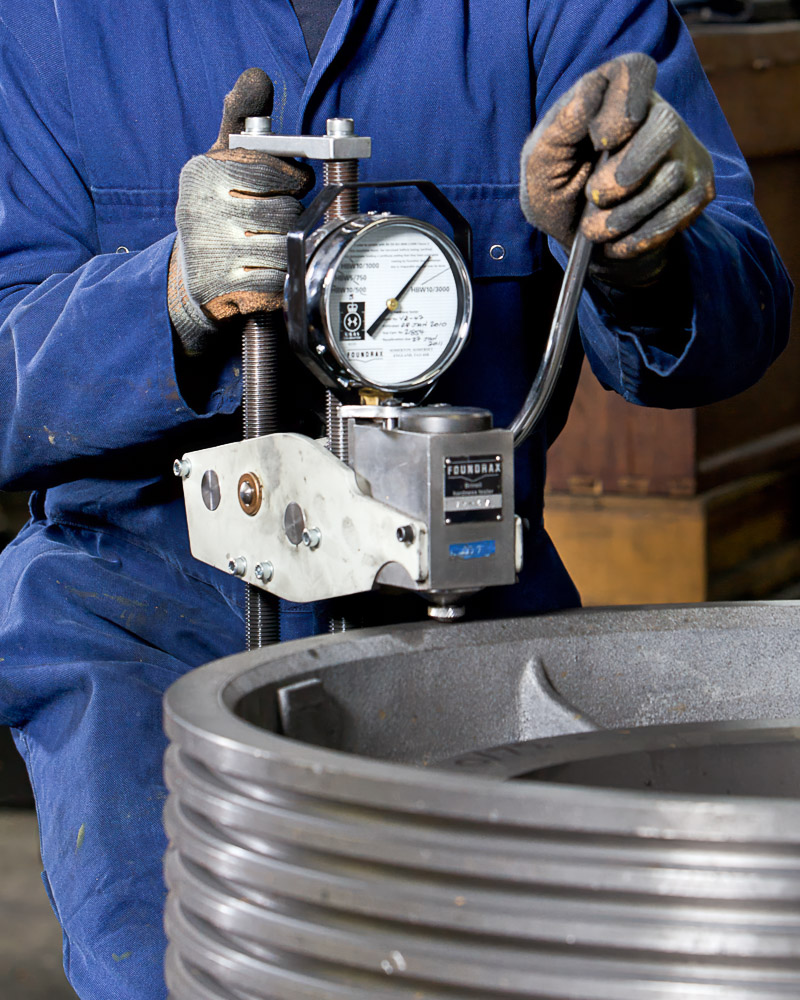
The portable Brinell hardness tester is the answer for large or immovable components. A well-designed hydraulic, hand-operated machine (our Model 134, for example (shown in the photo)) can apply the full 3000 kgf load required for testing ferrous metals in a unit less than 600mm tall. Accessories extend its versatility considerably: a chain adapter allows testing of cylindrical components from around 200mm up to around 1500mm in diameter, anywhere along their length; a long-ram head reaches over flanges or into recesses; a reverse adapter inverts ball and anvil for otherwise inaccessible positions. Railway track can be tested in situ.
A portable tester of this type remains accurate in whichever plane it’s positioned — and the wheeled variant (The MHMA – moving-head-moving-anvil) I described in a recent post extends the test aperture to over 900mm.
Safety must come first, and working outdoors demands particular care. The forces involved are substantial. Ensure the component is fully stable and cannot rock or shift during the test — movement under load will produce an inaccurate result and could cause injury. A moment spent assessing stability before applying load is time well spent.
Indentation measurement in the field has its own challenges. Manual microscopes can be adequate in the hands of a highly experienced operator, but an automatic Brinell microscope — returning a hardness value to a far higher resolution and with a far lower measurement uncertainty, in under a second (and eliminating operator subjectivity, which is generally the main source of error in testing) — is the better option by some margin. Rugged, battery-powered microscopes built for this precise purpose do the job properly.
Where results lead to critical acceptance decisions, the case for automatic measurement is, I’d say, irresistible.