At Foundrax’s inception over 70 years ago, the Brinell test was regarded in some quarters as somewhat ‘rough-and-ready’ — a good tool for simple testing, certainly, but perhaps not where real accuracy was required. The main reason was the difficulty of measuring indentation diameters accurately with a microscope and ambient light. Where, exactly, does the profile of the indentation created by the ball indenter end, and the ‘pile up’ of metal that’s been forced to the rim begin? This was the nub of the Brinell test’s weakness, and operator-dependent measurement was fraught with difficulties.
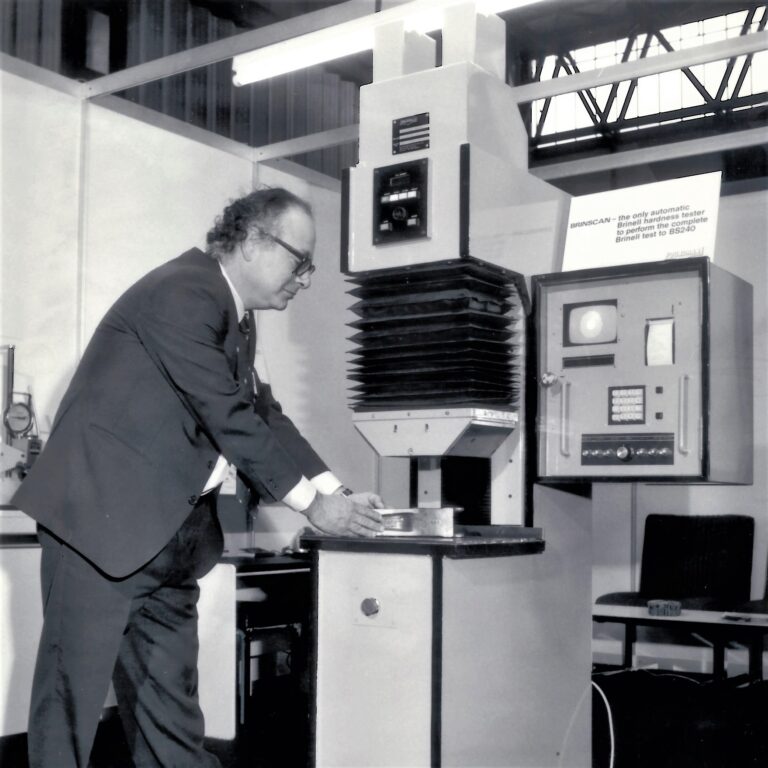
There was light at the end of the tunnel by the early 1980s, when my father, Charles Austin (then Foundrax’s MD), began a collaboration with Birmingham University. This led to the development of a microscope partnered by a dedicated computer which could judge indentation edge points accurately, and calculate the diameter across hundreds of axes, within a split second. An early version of this equipment is shown in the top photo — vintage tech!
In 1982 we launched the first automatic Brinell tester onto the market — the ‘BRINscan’ (shown here with my father demonstrating it) — and it self-checked and adjusted too. It came with completely integral optics and computer, and a screen that displayed the calculated hardness value boldly, to make life as easy as possible for operators in steelworks conditions.
It took a while to get market traction (it was an expensive option at the time) but this was a game changer. In 1990, Gill Wood, the National Physical Laboratory’s expert on hardness testing, told us that we had single-handedly transformed the perception of the test from problematic to highly reliable. Nonetheless, in 2000 the machines were still not common, and I think we have the QM of a major oil and gas customer to thank for spreading the word: back in 2002, he saw the improvement our equipment offered and proactively demonstrated it to companies in his supply chain.
In the late 1990s we launched a portable device — the BRINtronic — which utilised the same technology but in a ruggedised case with a hand-held scope. This device, along with our heavy-duty machines, remains in a state of continuous development and, at the time of writing, we’re trialling a new model.
An important consequence of this improvement in measurement accuracy was that manufacturing industry was able to tighten its acceptance criteria, which in turn drove improved measurement practice — ultimately bringing us to where we are today, with the Brinell test acknowledged as the most reliable method for getting good-quality hardness results in industrial shop-floor environments.